


Your shopping cart is empty!
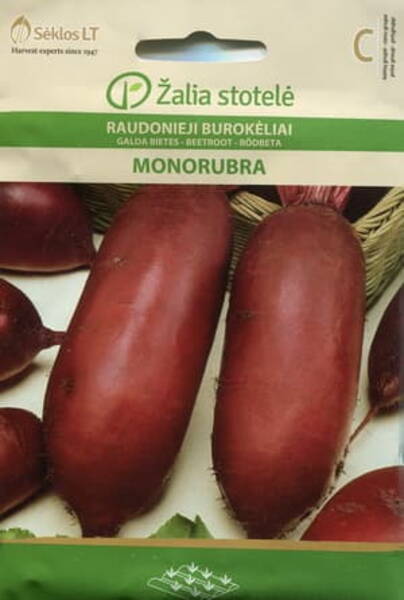
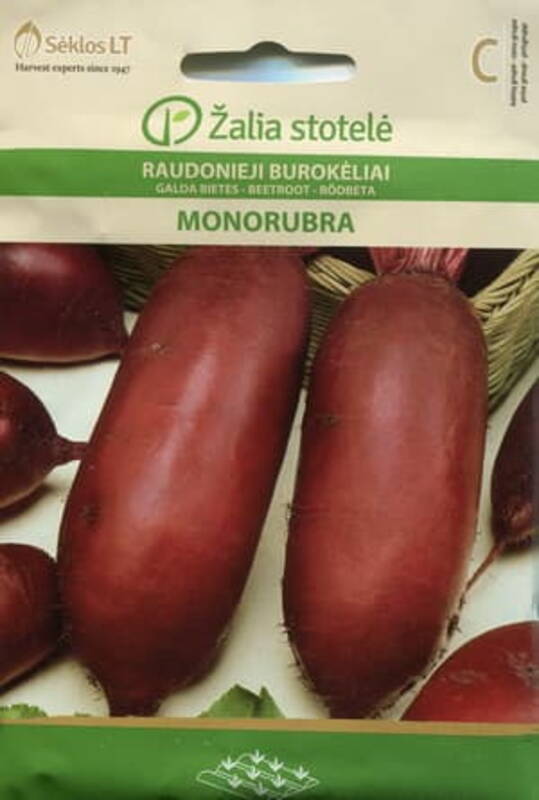
Beetroot "Monorubra"
Beta vulgaris var. conditiva Alef.
1.30€
Ex Tax: 1.05€
Ex Tax: 1.05€
Beetroot "Monorubra".
Monogerm (Single-seed).
Mid-season variety: 110-130 days. Root weight 180-350 g. Dark red colour. Optimal germination temperature +18...+20°C. Stores very well.
1.0 g = 40-55 seeds.
Monogerm (Single-seed).
Mid-season variety: 110-130 days. Root weight 180-350 g. Dark red colour. Optimal germination temperature +18...+20°C. Stores very well.
1.0 g = 40-55 seeds.
Beetroot is a valuable vegetable crop.
Its roots store excellently, allowing them to be consumed fresh all year round.
Beetroot is relatively drought-resistant and not very demanding of soil fertility. An increased need for moisture is observed only in the initial stage of growth, before the formation of the leaf rosette. At the same time, beetroot does not tolerate waterlogged soil — the roots acquire an unpleasant taste, and the plants become prone to diseases.
Growing secrets:
- Light and soil: Beetroot is very demanding of light but is salt-tolerant. With a lack of light (in the shade of trees or with dense planting), the roots grow small. It does not like acidic and swampy soils.
- Seed features: Ordinary beet seeds are fruit clusters (glomerules) of 3-5 seeds, so seedlings appear in "nests" and require thinning. The "Monorubra" variety is monogerm; one seed gives one sprout, which significantly simplifies care.
- Temperature regime: The optimal soil temperature for germination is +11°C. Seedlings withstand short-term frosts down to -3...-4°C, but adult roots freeze at -1...-2°C (frozen roots store poorly).
Agrotechnics:
1. Soil preparation: In autumn, apply 3 kg of superphosphate and 2 kg of potassium sulfate or ash. Beetroot is placed 2-3 years after the application of fresh manure. Nitrogen fertilizers should be applied with caution, as beetroot tends to accumulate nitrates.
2. Sowing: Carried out when the soil at a depth of 10-12 cm warms up to +7...+10°C (usually mid-May). Seeding depth 2-3 cm. Row spacing 20-25 cm.
3. Care and thinning:
- First thinning: in the phase of the first true leaf (leave 1-2 cm between plants).
- Second thinning: when there are 4-5 leaves (3-4 cm between plants).
- Final thinning: after 25-30 days (6-8 cm between plants).
4. Watering: Regular watering is necessary during the formation of root crops. Long breaks in watering lead to coarsening of the pulp, and a sharp resumption of watering leads to cracking of the roots.
Interesting fact: Seedling method.
Beetroot can be grown via seedlings (age 30-40 days). This allows you to get an early harvest and effectively use space on the plot (for example, planting along the edges of beds or after radishes). When transplanting, plants should have 3-4 true leaves.
Why is beetroot not always sweet?
Reasons: poor-quality seeds, acidic soil, or improper care.
Tips for sweetness:
1. Ash: Reduces soil acidity and supplies potassium (3 cups per 1 m2).
2. Salt: Ordinary table salt increases sugar content (1 teaspoon per bucket of water, rate per 1 m2).
3. Moisture: In dry and hard soil, root crops become bitter.